Ann Tarantino
Sunroom
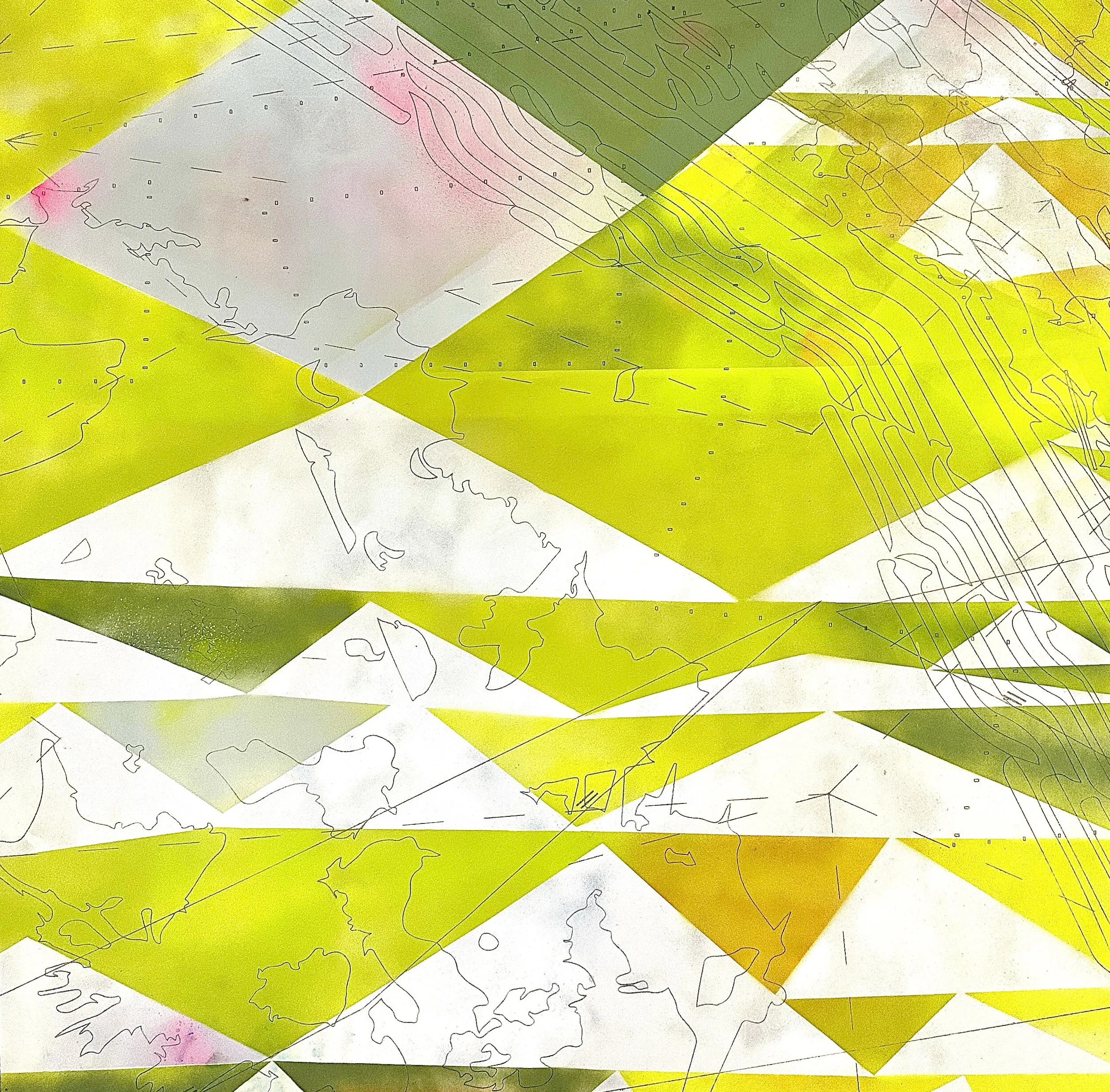
In Sunroom, Ann Tarantino brings color, shadow, line, and light into a shifting relationship between her paintings and the space that holds them. The exhibition brings together paintings, works on paper, and a window installation developed over the past two years through an ongoing collaboration with sunlight: its presence, its absence, and the shadows and traces it leaves behind.
Though distinct in form, the works are connected by an attention to light as both subject and material. Tarantino works with cyanotype, translucent vinyl, cut paper, etched lines, and layered paint to create images that are activated by, or derived from, natural light. Shadows cast across floors and walls become drawings; patterns are cut into paper to allow sunlight to pass through them; translucent vinyl on the gallery windows casts colored shapes into the room.
The window installation extends this process connecting to the architectural structure of the gallery. A layered geometric composition of translucent vinyl covers the gallery façade, allowing sunlight to pass through and project color into the interior. As the light shifts, the work changes. When the blinds are drawn, the projected forms meet the flat white blind, creating another iteration of the image, a vibrating echo of color, shadow, and shapes. The work is therefore never quite fixed. It depends on the movement of the sun, the conditions of the day, and the presence of the viewer. The works, and particularly the works in conjunction with the window’s colored reflections capture the harmonious light and color fragmentation of a kaleidoscope.
The shapes and line drawings that recur throughout Sunroom are in part abstractions of shadows and of data describing the movement of the sun and moon across the sky. Tarantino became particularly interested in the eclipses after experiencing a total solar eclipse two years ago from her Pennsylvania backyard. The event offered an unusual experience of scale and connection: something distant and cosmic, yet immediately visible, shared by people across large stretches of landscape at the same moment. This sense of connection across time and space carries into the work. The etched lines and cut patterns suggest forms of landscape paintings though their landscapes are not observed so much as constructed from the movements of celestial bodies and the effects of light.
There is also a material shift at the heart of the project. In making Sunroom, Tarantino has moved away from toxic materials such as aerosol sprays and airbrushes, developing a set of self-imposed rules around reuse and material responsibility. Existing paints could be used freely; new materials were purchased only when they offered a more environmentally considered alternative. These constraints became generative. A series of pink and orange drawings, for example, ended when the paint ran out. Leftover materials and remnants from earlier projects were repurposed into stencils. The flowing quality of the works in Sunroom reflect Tarantino’s organic process of letting materials lead her while Tarantino’s openness to let go of certain hazardous materials allowed for new innovations.
The resulting works in Sunroom reflect a practice grounded in looking: looking at a shadow on the floor, the changing light through a studio window, the behavior of a material, or the movement of the sun across the sky. Sunroom is ultimately an inquiry into how we see and what changes when we pay attention. Its forms are spare and deliberate, but they emerge from forces that are larger and less controllable—the sun, the moon, time, weather, and the material world around us. The inspiring eclipse was an event on a global scale but Tarantino’s subtle handling of her subject encourages viewers to celebrate smaller moments of looking and noticing.